Stepping off the cross-country puddle jumper commuter plane, one is hit in the face with a few things:
- The dry season heat and sun
- A rather primitive air transport arrival
- Old crumbling pavement being overtaken by dirt roads

Although Lethem itself has been around for a long while, it just recently became an official “town” in the eyes of the national government. Serving as the hub for Guyana Region 9, it is the largest settlement in southern Guyana even though the population is little more than 1000.
To describe it in one sentence would be a wild west rodeo border town mixed British colonial influence with ever-increasing infrastructure brought in by foreign interest.
The Takutu River separates Guyana from Brazil in this area. On the other side, the Brazilian border town of Bonfim speaks primarily Portuguese, although many speak English to accommodate trade with Guyana, which is South America’s only country with English as the primary language. It is quite a scenic place really, located on the vast Rupununi Savannah with the mighty Kanuku mountains towering south of town. This is leading to a growing market for ecotourism in the area.

Lethem and Bonfim are a sort of “Neutral Zone” between the two countries; people freely cross the border bridge for trade, work, and recreation. Therefore many of the businesses, products, food, and culture in Lethem are heavily Brazilian rather than the coastal Guyanese culture of mixed Caribbean creole. One benefit is it forces a necessity to learn some Portuguese. Most of the cars driving around town have Brazilian plates. It can be very expensive to own and operate a vehicle in Guyana so many here use motorbikes instead. This creates a traffic mix mash of motorbikes, cars, trucks, bicycles and pedestrians all sharing the same space. Add on top of that how Guyana drives on the left side of the road and Brazil on the right and it can be a mess. Looks more like a free for all at busy times. Otherwise it is relatively fine and safe here.
Neighboring St. Ignatius is an Amerindian homestead with a Jesuit Mission serving the area in the past. The rest of the surrounding communities are a mixture of Protestant and Pentecostal churches.

Other than the bridge linking to Brazil, there is only one primary dirt road in, and one primary dirt road out. Heading north-east the trail stretches over the North Rupununi Savanna, linking villages along the way and eventually to Georgetown – after a few hundred treacherous kilometers of bad roads, flooding, and washed out bridges. Heading southwest the trail takes you around the Kanuku Mountains to the south Rupununi Savannah, an area dotted by small isolated settlements of Ameridian peoples from tribes such as the Wapishanas. The trails are sometimes only passable in the dry season. The rainy season floods much rendering it impassable at times. This is where air transport for medical emergencies comes in handy.
RAM bases their Cessna U206A Utility Aircraft turned Air Ambulance at the Lethem Airport. Of interesting significance is the status of being the second longest paved runway in the country but is not lighted, has no instrument approach, and has no permanently based aircraft other than RAM. All the commercial carriers go home for the night in Georgetown a few hundred kilometers away.
The RAM pilot is provided with an apartment at one of the hotels in town. It is simple but cozy, with some ambiance set by previous RAM volunteer pilots. Everyone seems to leave a little something: a shirt, a cell phone charger, extra supplies, even a classic Kentucky back porch bug zapper lamp that hangs in the corner (works nicely on little skeeters).
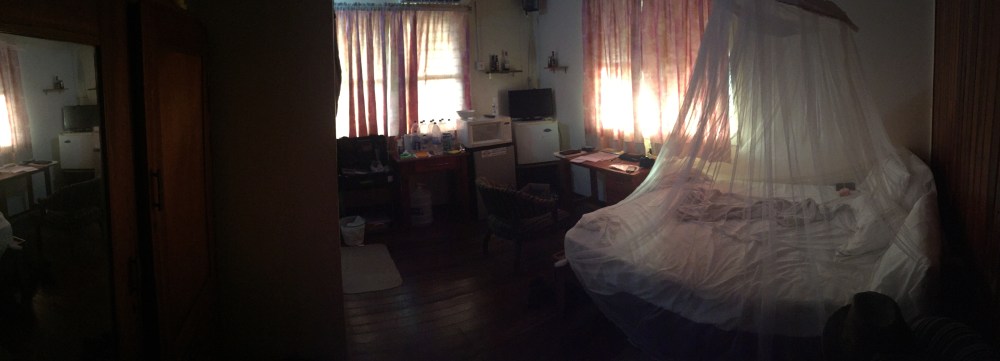
Serving as home and office, there are interesting qualities. occasional power outages sometimes occur (the village is powered by diesel generators). The water is untreated, not safe for consumption, sometimes does not run, and temperature dependent as to how much the sun heats the holding tanks. One does not get lonely here – there are all sorts of ants, mosquitoes, giant cockroaches, geckos, and other critters that also call this small space home. A bug net over the bed is a necessity to avoid the mosquitoes. Typically it’s the mosquitoes with malaria that bite at night.
It’s not such a bad place, so as long as one can learn to tolerate the loud music nightlife around town, live on a modified diet lacking in fruits and vegetables, avoid the water, and have patience with the crawling internet speed.
Lethem. It’s your friendly little outback village that is home away from home.
 TRAVEL FOR PURPOSE